1. Who This Guide Is For
Custom bag buyers come with very different priorities. A startup testing its first design cares about low MOQ and speed; a retail chain cares about audit compliance and stable capacity. This guide covers the decisions that matter at each stage, but here's how different buyers typically enter the process:
| Buyer type | Typical first order | What matters most | Suggested starting point |
|---|---|---|---|
| Startup & designer brands | 100–500 pcs | Low MOQ, fast sampling, one-stop development | ODM base style + custom logo & colors |
| E-commerce sellers | 300–1,000 pcs | Sample library for testing, transparent delivery tracking | Existing samples + material/color customization |
| Corporate gift & promotional buyers | 100–1,000 pcs | Classic styles, eco-compliant materials, strict inspection | OEM with custom packaging |
| Wholesalers & importers | 1,000+ pcs | Price, capacity, SEDEX/BSCI compliance | Bulk production with own tech pack |
2. OEM, ODM or Private Label: Choosing the Right Model
Before contacting any factory, decide how custom you actually need to be. This one decision drives your MOQ, development cost, and timeline more than anything else.
Private Label
You pick an existing style and add your logo, labels, and packaging. It's the fastest route to market and carries the lowest development risk — ideal for testing demand or filling a product line quickly.
ODM (Original Design Manufacturer)
You start from the factory's base design and modify it: dimensions, materials, colors, hardware, pockets, lining. You get meaningful differentiation without paying for full pattern development. Most first-time brands we work with start here.
OEM (Original Equipment Manufacturer)
The factory builds from your tech pack or physical sample. Maximum control, maximum spec responsibility — you own the design decisions, so your documents need to be precise. Best for established brands with clear product requirements.
| Model | You provide | Factory provides | Best for | MOQ impact |
|---|---|---|---|---|
| Private label | Logo artwork, packaging requirements | Existing style, sampling, production | Fast launch, low risk | Lowest |
| ODM | Reference photos, target specs | Base design + modifications | Most startups & e-commerce | Low–medium |
| OEM | Tech pack or physical sample | Full development from your spec | Established brands | Medium–high |
3. What to Prepare Before Requesting a Quote
Factories cannot quote accurately from a vague brief — "premium duffel bag, best quality" gets you a guess, not a quotation. The clearer your RFQ (request for quotation), the faster a serious manufacturer can assess feasibility and give you a realistic number.
The RFQ checklist
Before you send an inquiry, prepare:
- Product type and category — e.g. 40L travel duffel, weekender bag, backpack, cosmetic bag
- Reference images — 3–5 photos, with notes on what you like (shape, stitching, hardware finish), not just "copy this bag"
- Dimensions — H × W × D, plus handle drop and strap length where relevant
- Material direction — genuine leather, PU/vegan leather, canvas, nylon, polyester, RPET recycled fabric — or "suggest options within this budget"
- Logo method — screen print, heat transfer, deboss, embroidery, woven label, metal plate, rubber patch (uncertain? ask the factory to recommend based on your material)
- Estimated quantity and color breakdown — even a rough range helps the factory propose the right production route
- Packaging needs — polybag, dust bag, hangtag, gift box, barcode labels
- Target market — US, EU, etc. This affects compliance and material choices (e.g. REACH, CA65)
- Delivery target and destination port or warehouse
- Preferred trade term — EXW, FOB, CIF, or DDP
Do you need a full tech pack?
No — not for the first conversation. A complete tech pack helps, but drawings, clear photos with dimensions, and a written feature list are enough to get a feasibility review and a preliminary quote. If you have a physical sample of a bag you want improved or reproduced, that's even better: send it, and the factory can reverse-engineer the spec. What you should not do is send a request so vague that two suppliers would quote two completely different products — that's how buyers end up comparing prices that aren't comparable.
4. How to Choose a Reliable Custom Bag Manufacturer
Once you have a shortlist — typically 3–5 factories from Google searches, B2B platforms, or referrals — the vetting begins. Portfolio photos don't prove capability; comparable-product evidence and verifiable credentials do.
Ten questions to ask every factory
- Which bag categories make up most of your production volume?
- Have you produced a similar structure, material, or price tier before? Can you show an unbranded comparable sample?
- Is sampling done in-house? Is it done at the same site as bulk production?
- Which processes are outsourced, if any?
- What is the sample lead time, and what does a sample cost?
- What is your MOQ — per style, per color, per material, and per logo method?
- Can you break the quotation into sample fee, tooling/logo plate fee, unit price, packaging, and freight?
- What quality checks happen in-line, and can we appoint a third-party inspector?
- Which audits and certifications do you hold, and can I verify them on the Sedex platform?
- What are your payment terms and quote validity period?
The quality of a factory's questions tells you as much as its answers. A capable manufacturer will flag structural risks in your design, ask about material sourcing, and point out missing information — not just send you a number.
Verify credentials, not claims
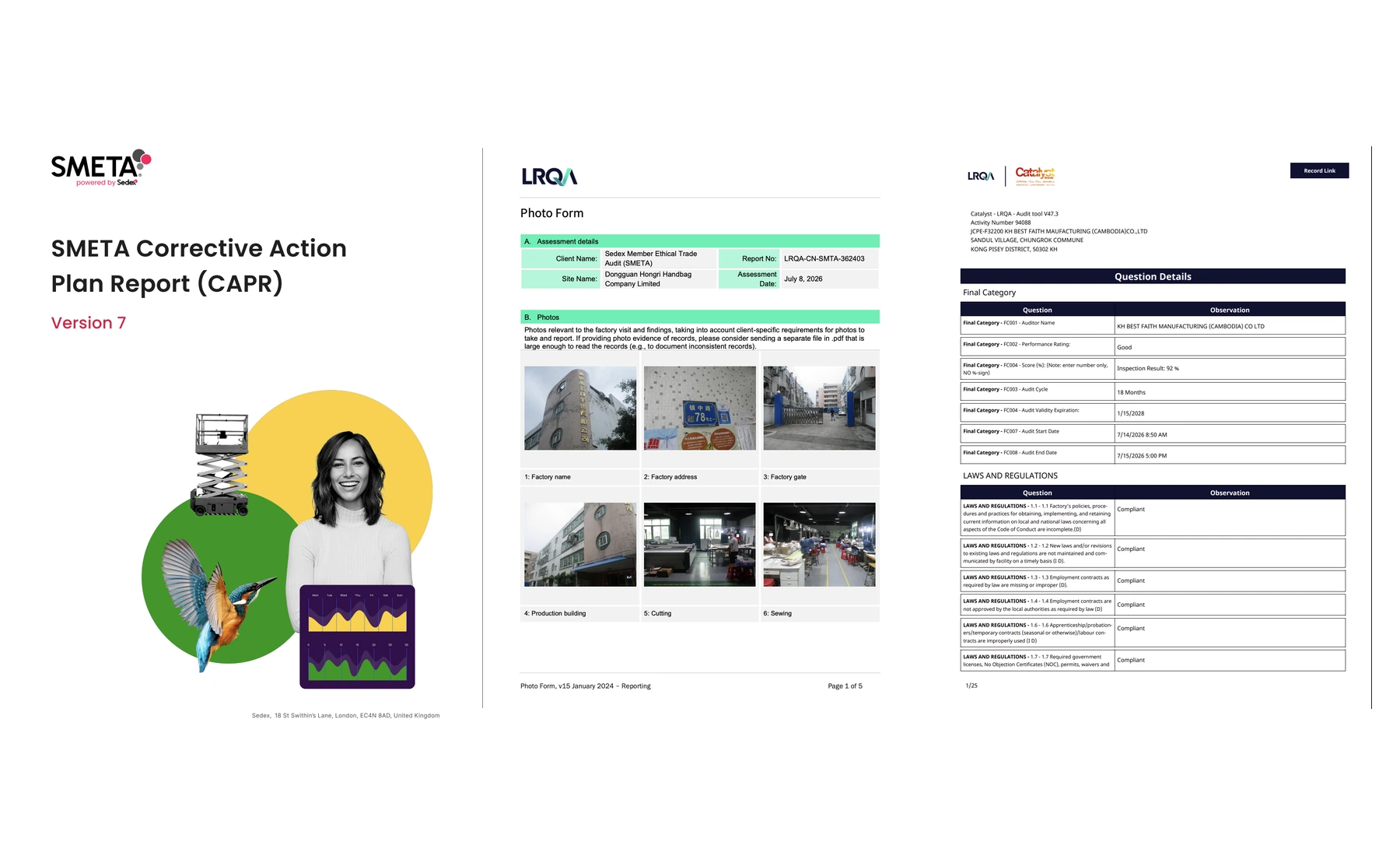
Any factory can write "SEDEX approved" on a homepage. The certificate list should be checkable — audit reports are registered on the Sedex platform, and buyers can request the site reference. As context for what to look for, our own facilities hold:
| Certification / audit | Scope | Why it matters to you |
|---|---|---|
| SEDEX 4-Pillar (SMETA) | Labour standards, health & safety, environment, business ethics | Required by most global retailers; covers supply-chain due diligence |
| BSCI | Social compliance | Common requirement for EU buyers |
| ISO 9001 | Quality management system | Consistent processes, not just one good shipment |
| Third-party audits (LRQA) | Independent on-site assessment | Audited by a party that doesn't sell you anything |
Red flags to walk away from
- The quotation lumps everything into one unit price with no breakdown
- The company name on the quote, the invoice, and the bank account don't match — and nobody explains why before payment
- "We manufacture all kinds of bags" but no evidence of your category or price tier
- Refusal to accept third-party inspection or a video factory tour
- Pressure to skip the pre-production sample to "save time"
5. From Design Idea to Approved Sample
Sampling is where most of your risk gets removed — or created. Treat it as a collaborative refinement phase, not a formality to rush through.
Step 1: Feasibility review and preliminary quote
Send your RFQ package. A responsive factory replies within 24 hours with a feasibility assessment, material suggestions, and a preliminary price — plus honest feedback on anything in your design that will drive cost or risk.
Step 2: Prototype or counter-sample
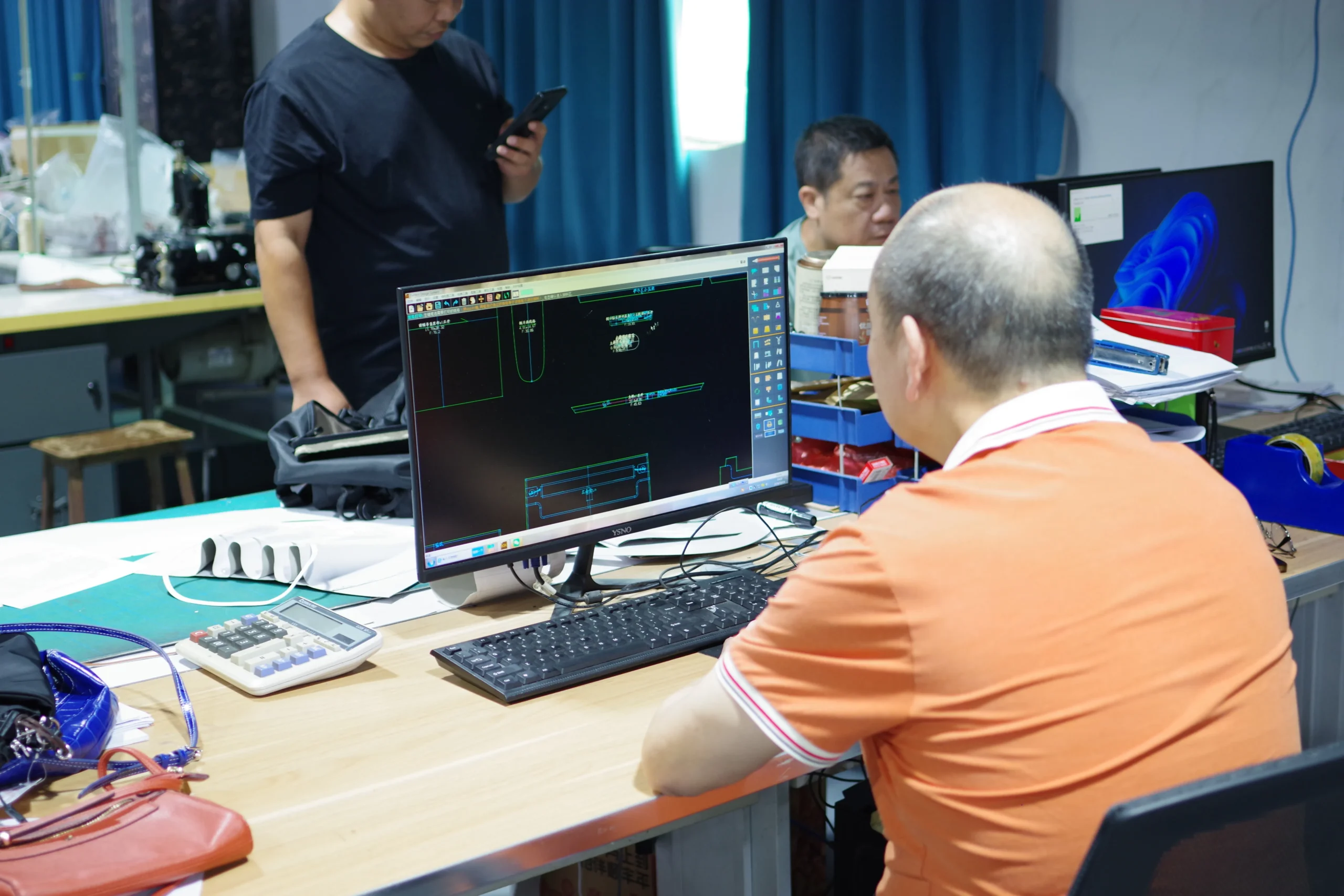
The sample room develops your bag from drawings, reference photos, or a physical sample. Expect questions: zipper brand and puller style, lining preference, reinforcement points, edge-paint finish. Answer these early and sampling gets faster. Typical sample turnaround is 3–7 working days, with rush options available.
Step 3: Pre-production sample (the golden sample)
Once the prototype is approved with final materials, hardware, and logo, a pre-production sample is made exactly to bulk spec. This becomes your golden sample — the reference both sides check bulk production against. Never skip this step, no matter how trustworthy the factory seems.
| Stage | Typical timeline | What you approve |
|---|---|---|
| Feasibility & quote | 24–48 hours | Scope, material direction, preliminary price |
| Prototype / counter-sample | 3–7 working days | Design, construction, dimensions |
| Pre-production (golden) sample | 3–5 working days after prototype approval | Final materials, logo, packaging — bulk reference |
6. MOQ, Cost and Production Planning
How MOQ really works
MOQ is not one number — it's several. A factory may accept 300 bags overall but require 300 pieces in one fabric color. Ask for each of these separately:
- MOQ per style
- MOQ per color
- MOQ per material
- MOQ per logo method
- MOQ for custom-dyed fabric or custom hardware
- MOQ for custom packaging
- Reorder MOQ (often lower than the first order)
Very small runs carry hidden costs: higher unit prices, limited material choices, standard hardware, and harder color matching. A slightly higher MOQ is often the better trade when it buys better materials and a smoother repeat order. For reference, Hongri supports orders from 50 pieces for own-brand projects, with MOQ adjusted by design complexity — startup-friendly first orders are part of how we work, not an exception we grudgingly make.
What goes into the unit price
When comparing quotes, insist on a breakdown:
| Cost component | What varies it |
|---|---|
| Materials | Fabric type, weight, lining, custom-dyed vs stock color |
| Labor & construction | Stitch count, reinforcement, structure complexity |
| Logo / branding | Method (print vs embroidery vs metal plate), placement count |
| Hardware | Custom zippers, pulls, buckles, branded metal plates |
| Packaging | Polybag vs dust bag vs gift box; inserts and labels |
| Testing | Waterproofing, load-bearing, colorfastness, restricted substances |
| Inspection & shipping | Final inspection, freight term (EXW/FOB/CIF/DDP) |
Two quotations are only comparable when they assume the same components and packaging. Watch for vague language like "premium material" or "high-quality hardware" — replace it with measurable specs before you sign.
Landed cost, not FOB
A low FOB price can hide expensive surprises. Ask for the total landed cost to your warehouse: unit price + tooling/logo plate fees + sample setup + packaging + testing + inspection + freight + duties. Rework, returns, and shipping delays from a cheap supplier usually cost more than the per-piece saving.
Payment and capacity
Standard terms in this industry are T/T with a 30% deposit and balance before shipment; irrevocable L/C at sight is also common for larger orders. On capacity, know your factory's ceiling before you need it in peak season — our Dongguan base produces 100,000–150,000 pieces per month across 6 lines, and our Cambodia base adds roughly 330,000 pieces per month, which is also useful for buyers diversifying production origins.
7. Quality Control Before Bulk Shipment
Quality control should start before production does — in the engineering stage, not at final inspection.
Where checks actually happen
A serious factory runs quality gates at every stage, not just at the end:
- Incoming material inspection — fabric, hardware, and accessories checked against the approved spec
- Cutting & preparation checks — material laid out and cut to pattern, components sorted and counted
- In-line inspection — QC on the production line at set intervals, catching problems while they're still cheap to fix
- Semi-finished checks — structural integrity, stitch consistency, hardware function
- Final random inspection — following AQL standards on finished goods
- Packing checks — barcode, hangtag, dust bag, carton marks verified before closing
- Functional testing — waterproofing, load-bearing, and colorfastness tests on sampled units per batch
Systems that make quality visible
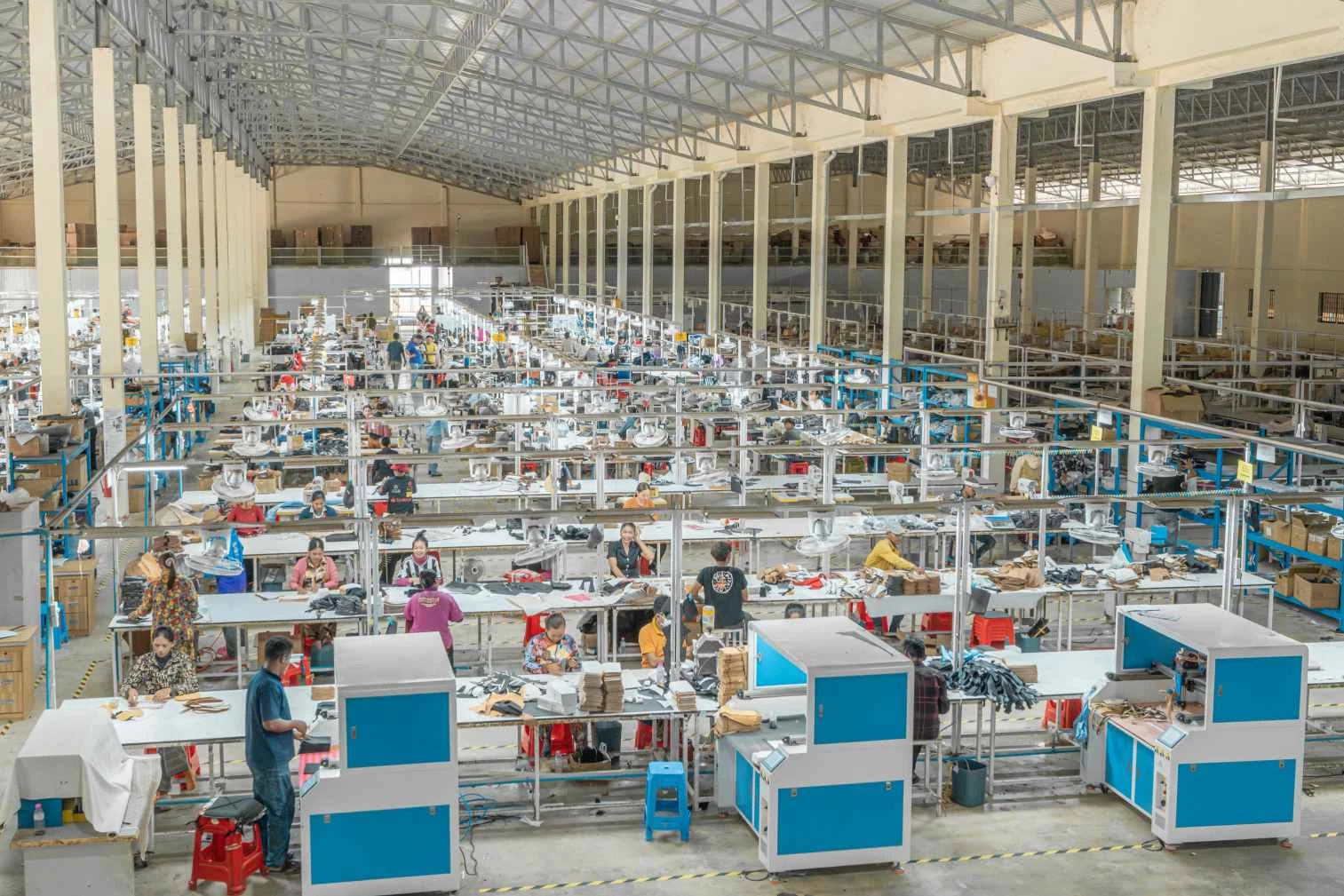
Ask how the factory proves progress to you. Our Cambodia facility runs a Four-Center operation — engineering, preparation, production, and assistance centers — where production standards are broken into process documents before a line starts, materials are stored on supermarket-style shelving to prevent creasing and count errors, and a dedicated center handles humidity control, appearance checks, and final packing. A Manufacturing Execution System (MES) covers scheduling, quality, and full-process traceability, and clients can log in to check their order's production status in real time.
Third-party inspection: welcome it
A factory confident in its QC welcomes your third-party inspector (SGS, Bureau Veritas, QIMA, or your own QC agent) and provides inspection areas, re-work space, and documentation. Refusal to accommodate third-party inspection is one of the clearest red flags in this industry.
8. One Partner, Two Production Bases
Why do established bag programs split production between China and Cambodia? The two bases do different jobs. Development, complex structures, genuine leather work, and fast sampling happen in Dongguan — close to material markets, hardware suppliers, and a deep industrial cluster in the Greater Bay Area. Large-volume standardized production runs in Cambodia at lower cost, with the same quality management and audit compliance. Buyers who need supply-chain flexibility — whether for cost, capacity, or origin diversification — can run one program across both, with the same engineering team and QC standards behind either site.
9. Customization Options: The Full Checklist
Use this as a menu when writing your RFQ — you can customize any combination of:
| Dimension | Options |
|---|---|
| Size & structure | Dimensions, silhouette, compartments, external pockets, opening style, straps & handles, closure systems |
| Materials | Genuine leather, PU/vegan leather, microfiber, canvas, cotton, nylon, polyester, oxford, RPET recycled fabric, mesh, denim, linings |
| Logo | Screen print, heat transfer, emboss, deboss, embroidery, woven label, metal plate, rubber patch |
| Colors | Shell fabric, lining, webbing & straps, zipper tape, piping & binding, hardware, logo, packaging |
| Patterns | Solid, stripes, plaid, geometric, all-over print |
| Hardware | Zippers & pulls, buckles & adjusters, D-rings & O-rings, hooks, magnetic snaps, logo plates, locks, chains, rivets, feet |
| Packaging | Dust bags, hangtags, care cards, polybags, gift boxes, color boxes, carton marks, barcode stickers |
| Lining | Polyester, nylon, cotton, suede-look, waterproof, printed, logo-branded, mesh pockets |
10. Frequently Asked Questions
Q1: What is the MOQ for custom bags?
Q2: Can you make bags from reference photos?
Q3: Do I need a tech pack to start?
Q4: How long does sampling and production take?
Q5: Can I mix different bag types in one order?
Q6: What are your payment terms?
Q7: How do you control quality on bulk orders?
Q8: Can you support private label projects?
Q9: Which certifications do your factories hold?
Q10: Can I visit the factory or take a virtual tour?
Start Your Custom Bag Project
You now have the framework: choose your model, prepare a precise RFQ, verify the factory, approve a golden sample, and control quality in stages. The next step is a conversation with specifics — send your design, reference photos, or just a description of what you're building, and we'll come back within 24 hours with feasibility, material options, and a preliminary quote.
Contact Us to Get a Quote